
Sandy lovingly refers to her daughter, Elsa Maria, as “Elsie.”
“To know her is to love her,” Sandy says. “She is just pure love and joy.”
Elsie was born healthy and went to daycare while Sandy and her husband Jim worked full-time. She came home sick often, but it was the developmental delays that truly worried Sandy and Jim. By five or six months old, Elsie was not meeting milestones. Her pediatrician dismissed Sandy’s concerns and denied her request for an early intervention referral.
Elsie’s head circumference was also unusually large, while the rest of her body remained very small for her age.
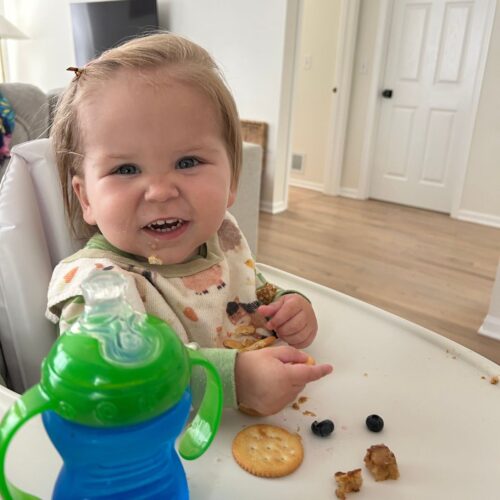
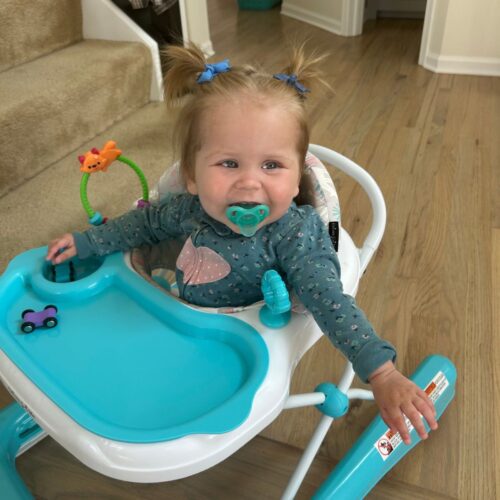
At eight months old, Elsie was hospitalized with pneumonia. Afterward, she showed clear signs of regression. Even her daycare provider noticed the changes and mentioned them to Sandy. Still, their pediatrician remained dismissive. He eventually referred them to early intervention, but offered no further guidance.
Because Elsie did not have the muscle tone to turn her head or roll while sleeping, the weight of her large head caused it to flatten, and she needed a helmet.
Sandy’s mother, an internist, urged Sandy to find a new pediatrician. Sandy also self-referred to a pediatric neurologist, though the earliest available appointment was two and a half months away.
For a brief time, Elsie seemed to progress. She could sit independently by eight months old. Then, at about eleven months, just weeks before her scheduled MRI, she regressed again. At the same time, Sandy was nine months pregnant with their second daughter, Sofia.
Elsie’s parents suspected hydrocephalus due to Elsie’s large head circumference and repeated regressions.
The MRI took much longer than expected. When the doctor brought Sandy and her husband into a private room, her heart sank. “Please don’t let this be a tumor,” she remembers thinking, not knowing what could be worse.
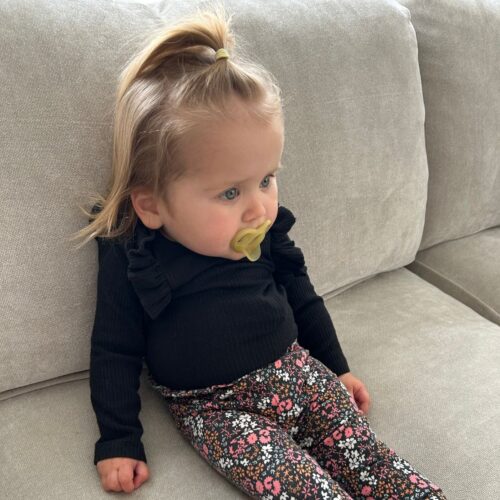
The scan showed excess fluid in Elsie’s ventricles: hydrocephalus. A neurosurgeon treated her immediately, placing a shunt. Within days, Elsie was smiling more and seemed happier. Follow-up imaging, including a spinal MRI, showed no lesions or other abnormalities. Sandy felt hopeful again. One month later, she gave birth to Sofia.
But Elsie eventually plateaued. She missed milestones and shook in pain during intensive physical therapy. Their new pediatrician recommended genetic testing, wanting to understand the root cause of the hydrocephalus and developmental delays.
While waiting to see a geneticist, Elsie entered a new intensive therapy program and caught the flu. About three weeks later, she could no longer sit independently. Bath time, once joyful, became excruciating. Sandy’s mother had a strong intuition that something was seriously wrong. She urged Sandy to return to the pediatrician, who sent Elsie back to the hospital. “This seems like maybe Guillain-Barré,” Sandy recalls being told.
Elsie was admitted. Doctors ran full brain and spinal MRIs, along with a spinal tap. They found lesions in her brain and elevated protein in her spinal fluid, which supported the Guillain-Barré diagnosis. Treatment with IVIG began. At the same time, genetic swabs were sent out. The six-week wait for results felt endless.
Then came April 11. “It was literally the worst, worst day of my life,” Sandy says.
Elsie was diagnosed with Leigh syndrome caused by a SURF1 gene mutation inherited from both of her parents. After fearing her daughter might have cancer or a lifelong disability, Sandy was now facing the unimaginable pain of her daughter’s terminal diagnosis. There is no cure, no treatment, and a typical life expectancy of just three to six years.
Elsie is now two and a half years old.
Sandy wants to make sure her daughter is never forgotten.
Sandy and Jim know that they do not want Elsie intubated, though Sandy admits she cannot predict how they will feel when that moment comes. Still, Sandy’s deep, spiritual, almost otherworldly connection to Elsie tells her that her daughter would want to be at home when she passes.
Today, Elsie is on hospice and has experienced a remarkable shift since her diagnosis and last hospitalization. She returned to eating her favorite comfort foods for a period of time (she is currently now only tube fed). Elsie started moving around again with her seated baby walker, and returned to doing her favorite activities. Deciding to put Elsie on hospice care was one of the best decisions that her parents made for her. Sandy and Jim knew that Elsie needed to be in the comfort of her own home, surrounded by her family and loved ones. Elsa Maria continues to play with her favorite toys and loves interacting with her baby sister.
Elsie’s birthday, August 15th, also happens to be the Assumption of the Virgin Mary. In the Catholic faith, Mary represents purity, love, light, and joy—qualities Sandy sees so clearly in her daughter. Elsie’s middle name, Maria, was chosen to honor her grandmother, not Mary. Yet the connection feels meaningful all the same. And in Elsie, Sandy sees an angel on Earth, here to teach the world what pure love looks like.