
When Jennifer Emerson says her son’s name, her voice steadies in a way that has nothing to do with surrender. It is the voice of a parent who has learned to live in a world where machines, doctors, and sudden crises are part of the daily rhythm. Malachi has spent most of his life facing a disease that few people know exists, and even fewer people understand. Still, he was born into a family that will not let him be reduced to a diagnosis.
Malachi was born in June of 2017. The family already had Lina, who had been recently diagnosed with Leigh syndrome. Jennifer remembers the shock of that time. “We got the official diagnosis the day after Christmas, 2016. I was pregnant with Malachi. Suddenly we were told 100% he was going to have Leigh. I hadn’t even told a lot of people I was pregnant yet,” she said. “Of course, we were online looking up Leigh syndrome. I had seen it before but … [dismissed] it because it sounded really extreme. And then I was just like, oh my gosh, my baby is already fighting a disease.”
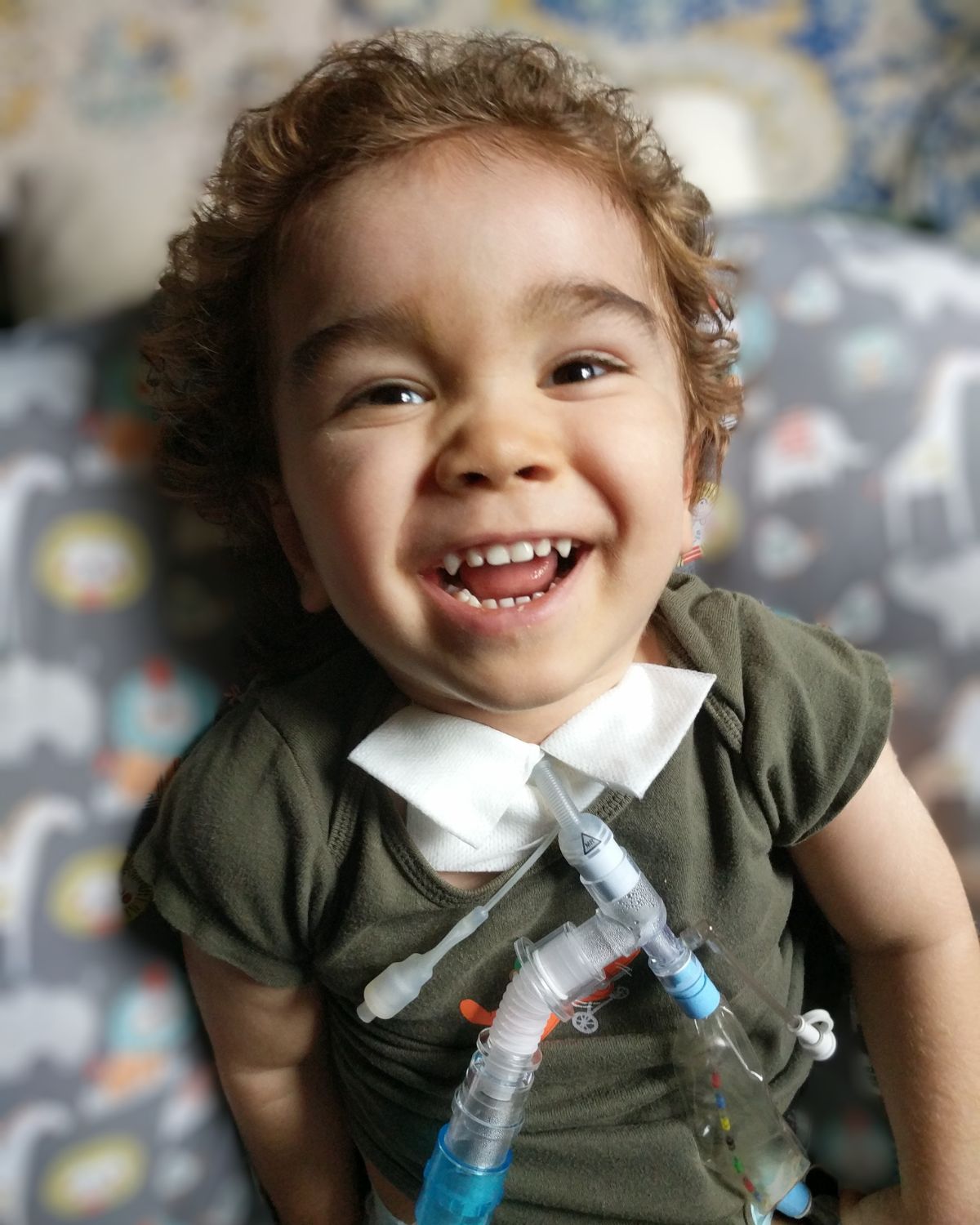

Two weeks after Malachi was born, his diagnosis was confirmed. For Jennifer and Evan, constant vigilance folded into everyday life. Appointments multiplied. Therapies were scheduled. Still, they treasure the moments when Malachi can simply be a child. “He thinks it’s hilarious when I smell his stinky feet,” Jennifer said, laughing.
Clinical crises punctuate their family story. Once, in the middle of the night, Malachi pulled out his trach. He lost his pulse for about nine minutes. The household spun into emergency protocol. Jennifer moved with a discipline learned from repetition. “We had to act immediately,” she said as she recalled “working a code” in her child’s bedroom. They had already experienced the same horror with Lina. Each close call was as traumatic as the last, leaving Jennifer and Evan forever changed.
Jennifer emphasizes that learning to speak the language of medicine became a matter of survival. She became an interpreter between two worlds: a mother’s intuition and the jargon of specialists. “You have to learn how to speak so doctors listen,” she said. While this is one small part of her labor, it explains why she knows the staff at her local hospital by name, why she can anticipate which doctor will push a discharge a day too early, and why she can insist on testing for things some doctors might too quickly dismiss as “disease progression.”
Her relationship with medical teams is not only practical. It is deeply personal. Jennifer recalls her time in the hospital with Lina before she passed away. “We made sure they knew first and foremost that she was not just a patient, she was a little girl, and she was my daughter.” She does the same for Malachi.
Years of shared compassion formed alliances that mattered when systems failed. When Child Protective Services was called on Jennifer after a nursing agency failed to provide in-home care, the social worker at the local hospital was furious on the family’s behalf. That relationship gave Jennifer the support and advocacy she needed to navigate a system that so often fails families like hers.
Jennifer does not like being labeled as “brave.” She compares herself to someone in a burning building, holding her children close. “The firefighters are brave. They have the choice of whether or not they run into that burning building,” she said. The Emersons never had that choice. Jennifer’s calm in the storm remains remarkable. Her perseverance in the face of trauma, exhaustion, and living grief is proof that we can keep going, even under extreme pressure.

Jennifer wants to world to know Malachi for who he is: “a tender-hearted, if slightly mischievous boy who loves people, all types of music and being silly with his family.” She adds, “He definitely misses his big sister who was always his favorite person in the world.”
What Jennifer offers at the end of our conversation is not platitude, but practice. “More than anything, I just want Lina and Malachi to know I love them.” Through her tireless caretaking, advocacy, and the beautiful moments she shared with Lina and continues to share with Malachi, it’s hard to imagine a world in which they don’t know how deeply they are loved.