
Verity watches carefully, taking in the world around her before deciding whether to let someone in. But once she feels comfortable, her personality shines. “She tends to be pretty reserved until she gets to know you really well, and then she is sassy as all get out,” her mom, Deborah, says with a smile. After many hospital visits and medical procedures, Verity has learned to advocate for herself early. “She does not have a problem telling you no if she doesn’t like something.”
Behind that sass is a gentle heart. Deborah describes her daughter as nurturing and affectionate, especially toward babies and animals. “She’s very sweet. She’s very mothering. She loves baby animals.” Verity also loves music, dancing, and wearing pretty dresses. She dances by holding onto the TV stand, stepping side to side and waving an arm, sometimes spinning in circles on the floor.
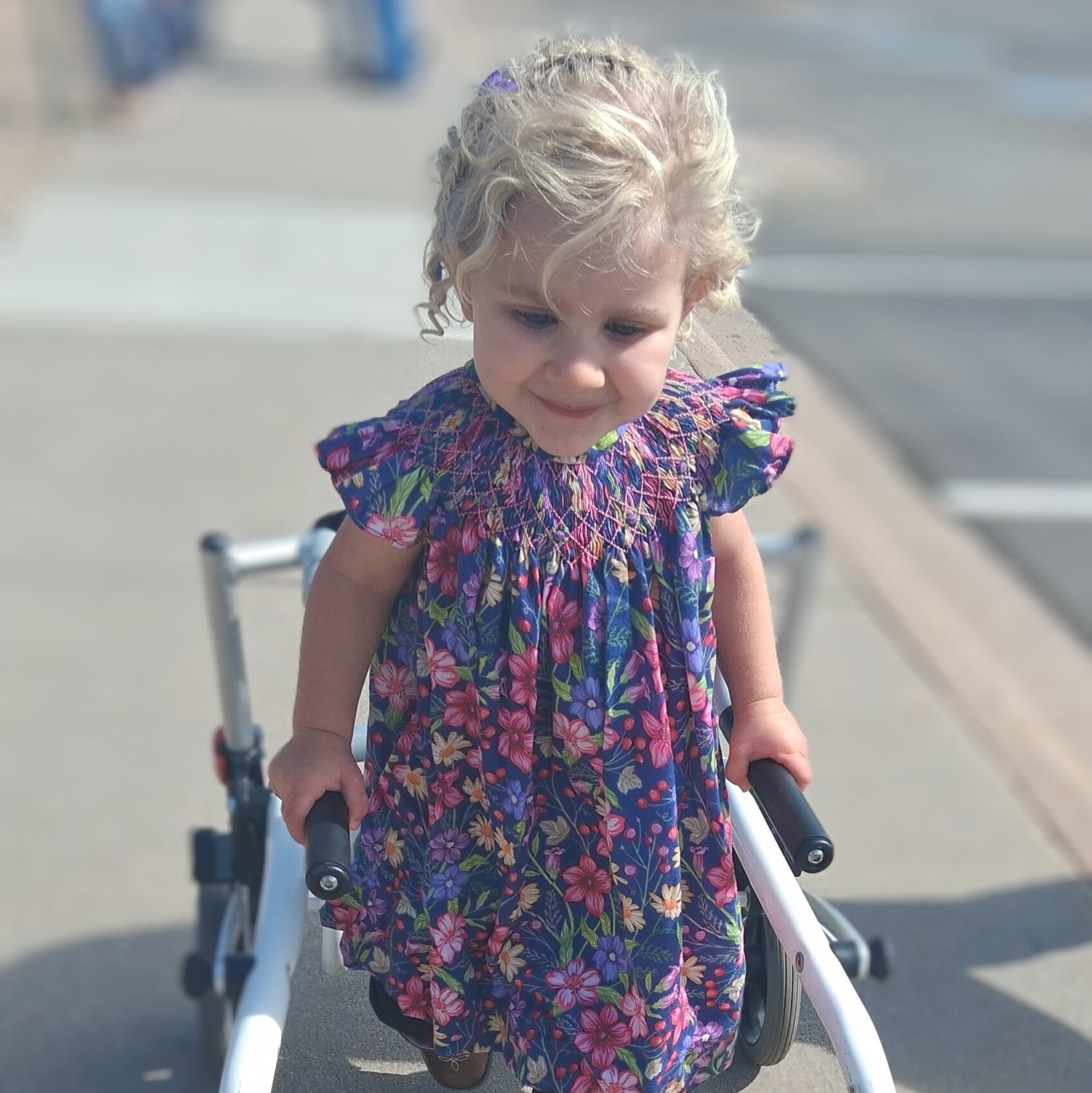
Today, Verity is doing remarkably well medically. “Her symptoms are really mild compared to most kids diagnosed early on,” Deborah explains. Most of Verity’s challenges center around nutrition and mobility. A feeding tube helps her grow and thrive while still allowing her to enjoy meals with her family. “She gets all her nutrition that way, and then she just eats what she wants to,” Deborah says. She also uses a walker to help her get around.
The first signs that something might be wrong appeared gradually. At 18 months old, Verity was not walking the way her siblings had at much earlier ages. Deborah wasn’t worried about timing alone, but something felt different. “The way that her steps were a different kind of wobbly made me nervous,” she recalls. Verity was also extremely small for her age. Even now, her younger brother, born fourteen months later, is taller than she is.
Earlier concerns had begun when Verity was just five months old and suddenly started vomiting everything she ate. After a hospitalization for failure to thrive, doctors attributed her symptoms to reflux. For months, Deborah focused on getting calories into her daughter, believing the issue was feeding rather than something deeper.
For nearly a year, things seemed manageable. Then, after a severe illness around Christmas 2023, the vomiting returned and would not stop. Multiple emergency visits followed, along with growing concern that something more serious was happening.
Advocating for answers proved difficult. Deborah felt her concerns were often dismissed. Determined to find help, the family sought care at a different children’s hospital two hours from home. There, doctors immediately ordered an MRI, which revealed metabolic abnormalities and began the search for a genetic explanation.
Eventually, genetic testing confirmed the diagnosis: SURF1-related Leigh syndrome.
Receiving that news was overwhelming. Deborah and her husband were told the diagnosis over the phone, leaving them to search for answers on their own while waiting for a follow-up appointment. Online information was outdated and frightening, suggesting many children did not live past early childhood. Verity was just turning two. “We celebrated the tar out of that birthday,” Deborah recalls.
When they finally met with their medical team, the conversation brought something they desperately needed: hope. Doctors explained that Leigh syndrome exists on a spectrum and that Verity’s progress, especially after receiving a feeding tube, was encouraging. Verity began gaining weight and growing stronger. “She had chubby, chubby cheeks within like three weeks,” Deborah says. For the first time, feeding no longer felt like a constant battle.
Since then, Verity’s care has focused largely on supportive therapies and supplements rather than medications. Deborah is grateful for that balance. “All of her medications are just supplements… things that I would feel comfortable giving to my kids long term.”
The family later relocated to Colorado with the military, beginning again with a new medical team. Living an hour from Children’s Hospital Colorado presents logistical challenges, especially when accessing physical and occupational therapy, but Deborah remains hopeful.
Physical therapy previously helped Verity meet a milestone Deborah still holds close. Watching her daughter climb steps felt monumental. “Usually taking a step upward would mean her ankle would fold in,” she explains. “And she was plowing up those stairs.”
Despite the uncertainty, much of Verity’s daily life feels beautifully ordinary. Cognitively, she is thriving and often ahead of expectations for her age. She adores people and has found a welcoming community at church, where older children eagerly help her navigate the playground with her walker. “It’s like she’s a little princess with an entourage,” Deborah laughs. “Everybody just loves her.”
At the same church, the family experienced an unexpected moment of connection. They happened to sit beside a couple who had a child with the exact same rare genetic condition. Although that child had passed away, the meeting provided guidance, understanding, and reassurance during a lonely transition to a new place.
Deborah’s in-laws regularly travel from Texas to help whenever needed, and daily caregiving currently feels manageable because Verity is stable. “Most of the time, things just feel pretty normal,” Deborah says. “We just enjoy time we have with her, as we do with all of our kids.”
Verity is the third of four siblings, soon to be five, and she embraces her role wholeheartedly. She especially loves babies and eagerly helps care for younger children, already preparing for the arrival of a new baby brother.
Like many parents of children with Leigh syndrome, Deborah lives with awareness that circumstances could change. Moments of fear still surface unexpectedly, like when Verity falls or shows unusual symptoms. But those moments do not consume their days.
Instead, Deborah focuses on what is true right now: Verity is joyful, social, and growing in her own way.
Her advice to other parents: every diagnosis and prognosis is different, and there is no single emotional roadmap. Fear is natural, and uncertainty is real. What matters most is learning to live alongside both.
For now, Verity’s resilience shines through in the little things: dancing in the living room, playing with her siblings, making friends at church, and celebrating every small step forward.